Case study
Where Bank of Hawaii Can Win More AI Answers
Present in 72.5% of AI answers. THE Answer in only 1 in 5. And that still put it ahead of every other bank.
Findings · 40 checks · 4 AI engines · July 2026
Who AI answers named as THE Answer
Out of 40 checks. Bank of Hawaii leads, but no bank owns the answer. 32 times out of 40, someone else got it.
All other sources: 12 of 40. Chase · Hawaii State FCU · Hawaii SBDC · Maui FCU · HLEFCU · CFPB.gov · three finance websites. None more than 2.
| Source | Checks |
|---|---|
| Bank of Hawaii | 8 |
| American Savings Bank | 7 |
| First Hawaiian Bank | 6 |
| Central Pacific Bank | 4 |
| HawaiiUSA FCU | 3 |
| All other sources | 12 |
How often each engine included Bank of Hawaii at all
Findings
Bank of Hawaii showed up a lot. Across ten real customer questions and four AI engines, it was cited somewhere in 29 of 40 answers. But it was the answer only 8 times. That was still the most of any bank. No one owns these answers yet, and the gap is the opportunity.
Overview
Bank of Hawaii measures its website by three things: new accounts, booked appointments, and submitted web forms. So the question wasn’t whether the bank ranks. It was whether AI answers send customers its way at the moment they decide.
I picked ten questions a real customer would ask (checking · savings · mortgages · HELOC · credit cards · small-business financing), each tied to a conversion goal. I asked all ten in July 2026, in four engines (Google AI Overviews · Perplexity · ChatGPT · Microsoft Copilot). For each of the 40 checks I logged two things separately. Did Bank of Hawaii show up at all? And which source did the engine treat as the answer?
About a month later I ran it again with three AI-visibility tools (Profound, Peec AI, and Otterly). Same pattern.
Challenge
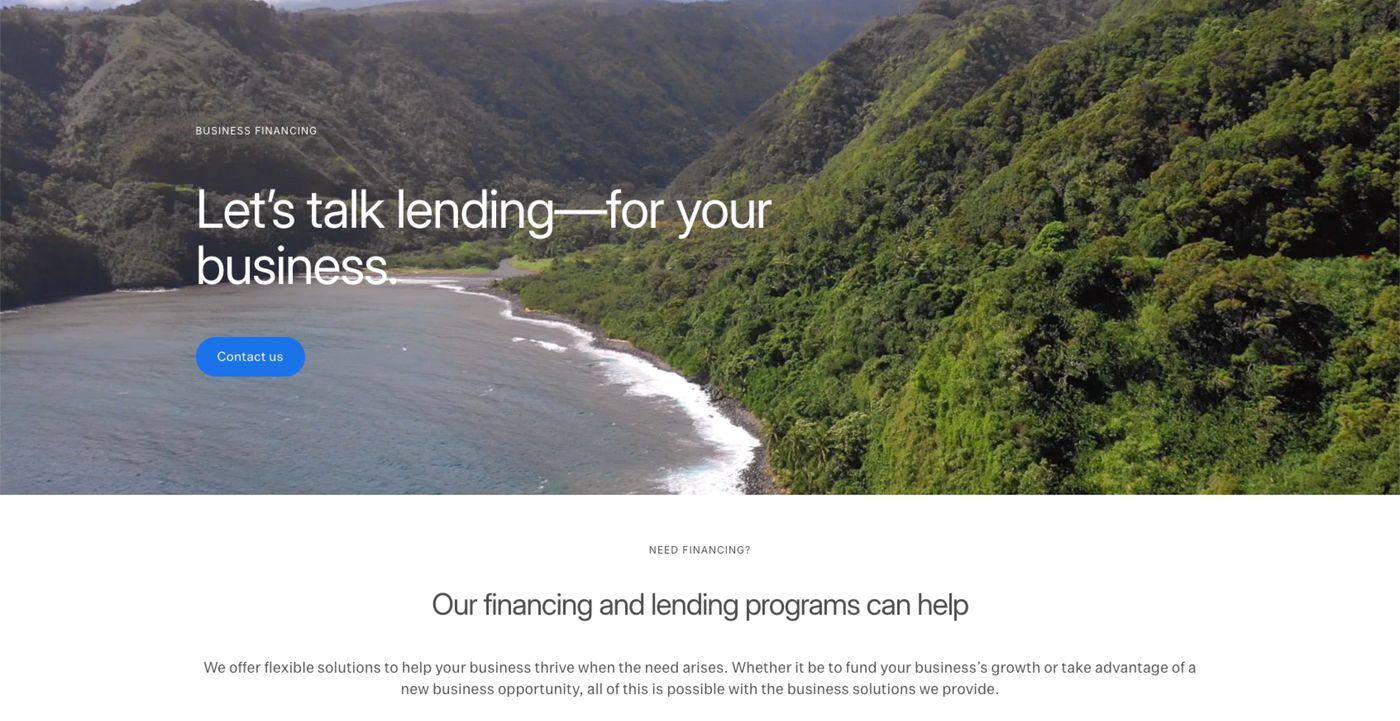
Showing up wasn’t the problem. Being the answer was. Take a small-business owner asking how to apply for a loan in Hawaii. Bank of Hawaii appeared in only 2 of 4 engines, and never as the answer. The engines reached for Hawaii SBDC and First Hawaiian Bank instead. Hawaii SBDC’s page gives loan types, real dollar amounts, and a numbered checklist. Bank of Hawaii’s pages read like sales pages. Built to convert, not to answer.
Solution
I ran the study with my six-phase AEO/GEO framework (Discover → Audit → Diagnose → Plan → Implement → Measure). The goal was a diagnosis a bank’s web team could act on, not a dashboard score.
Key features
- A fixed question set. Ten real customer questions. Each one tied to an account, an appointment, or a form.
- Two scores, never blended. Present and THE Answer are tracked separately. They move at different rates.
- Four engines, one day. The 40-check matrix behind every headline number.
- A Google deep dive. Day two looked closer at AI Overviews, whose answers shift in real time.
- Three-tool replication. Profound, Peec AI, and Otterly a month later. Each checked against the others.
- One validated fix. FAQPage markup built from nine real Q&As on the bank’s FAQ page. Zero errors and zero warnings in the schema.org Validator. Not deployed.
A second run, three tools, same pattern
A month later, three tools each ran the same five-question set on their own. Checking and Savings came out strongest in all three. Mortgage came out last or near-last in all three, on every metric I checked. Two of the tools independently pointed at the same likely cause: Hawaii’s first-time homebuyer program pages, where the bank doesn’t appear. That one is a strong lead, not yet confirmed.
| Topic | Profound visibility | Peec AI visibility | Otterly brand coverage | Verdict |
|---|---|---|---|---|
| Checking | 93.3% | 100% | 100% | Strongest |
| Savings | 73.3% | 67% | 100% | Strong |
| Mortgage | 26.7% | 33% | 25% | Weakest |
Each tool measures differently, so compare the agreement, not the numbers across columns. Full breakdown in the Cross-Platform AI-Visibility Validation.
Recommendations
- Put real numbers on product pages (APYs, minimum deposits, and loan amounts) where an engine can find them.
- Build a long-form small-business loan guide and link it to the application, so the conversion still happens.
- Mark up the 77+ questions already answered on the FAQ page.
- Check whether the bank is listed on the state’s first-time homebuyer pages. It’s the biggest mortgage lead.
Let the educational page teach. Let the sales page sell.
What this does and doesn’t show
This is independent research, not a client engagement. Nothing shipped to boh.com, so a future re-run will measure drift, not impact. The numbers are what four engines and three tools said in July and August 2026. AI answers change, so treat them as a snapshot.
Want to know where your clients are THE Answer?
I run this for agencies, under your brand. A 20-minute call is the easiest way to start.
Book a 20-minute callCompanion pieces
AEO/GEO Visibility Audit Framework
The six phases behind this study.
View the PDF →Cross-tool validationCross-Platform AI-Visibility Validation
Profound vs. Peec AI vs. Otterly, and what their agreement proves.
View the PDF →Work sampleFAQPage Structured Data
The validated fix from this study, built from live FAQ content.
View the PDF →